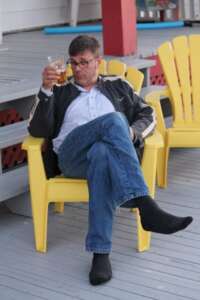
My friend Rob Harris died 10 years ago, on May 14, 2016. I wrote this story about him the following week and it was published on the website he founded, Canada Motor Guide, which no longer exists.
According to Rob Harris, there is no afterlife. No Heaven or hell, no wondrous place to walk into the light, no pearly gates or puffy white clouds or even fire and brimstone. Just – nothing.
He’d tell you this over a pint at the end of the day or, better yet, with his size 14 feet up on the edge of a table that held a bottle of reasonable scotch and a pair of half-filled glasses. And you and he would talk about many things: the Great Void; foreign policy; motorcycles, of course. This would continue for hours, until you were both tired enough for bed. But what you wouldn’t talk about would be Rob Harris, because he was more interested in you than in himself. You’d go to bed and never realize that while you knew more about his beliefs and your own, you didn’t really know where these ideas had come from – what formed them in his life.
Rob’s gone now, killed in a motorcycle crash, dead in the blink of an eye. Whether he’s looking down on us or not we’ll never know, not in this life at least. But picture him on the chair opposite, looking at you with that cheeky grin or maybe that good-natured little smirk, silent now for someone else to hold the air. He’s nodding that it’s okay. It’s time to tell his story.
***
Rob was born 49 years ago in Harrogate, a Yorkshire town, at – if you can believe it – Number 24, Cold Bath Road. “And his house was tall, tall like him, it went on and on up.” That’s Courtney talking, Courtney Hay, remembering her 6-feet-4 partner and the father of their children, Cate, 8, and Chloe, 7.
He was the youngest of three. His mother, Janet, a social worker, died from breast cancer when Rob was only six years old and he pretty much ran amok with his brother Michael, or Mitchy, and his sister Sarah, who were three and five years older. Their father Donald, a property adjudicator, would drop them off at a rented cottage in the summer and leave them to themselves all day. The three were tight-knit and watched out for each other in everything they did. When Rob was 10 years old, Donald sent his kids to Canada to stay for the summer with their mother’s sister, Margie, who lived near Montreal. Donald remarried and his new wife wanted nothing to do with the children; when Rob was 16, his father moved away to the south, leaving his kids to fend for themselves even more.
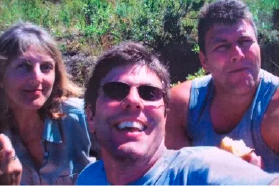
Soon after, Rob inherited £5,000 from his grandfather and used the money to travel to Australia. He spent the better part of a year there, 17 years old and on his own, staying with distant relatives and new friends, and it gave him the itch to see more of the world. “He learned perspective and self-sufficiency and independence and responsibility,” says Courtney, describing the humanist principles of his parents, “and how you need to count on yourself and do it.”
Rob demonstrated this every day of his life by being a vegetarian surrounded by carnivores. A friend told him about factory farming and he decided early on that he wanted nothing to do with eating meat. He never imposed this decision on others and would sit happily with friends eating burgers and steaks, but he’d be the one with a cheese pizza, or a salad. “Nothing with an anus,” he’d say. A friend remembers waving a scallop under his nose at a mealtime years later: “I can’t see an anus on this,” he teased. “Maybe not,” shot back Rob, “but I can see an anus holding it.”
Eventually, in Australia, he ran out of money, so broke he didn’t even own a pair of shoes, so he returned to the U.K. and signed up for a one-year motorcycle mechanics program in London. He earned top honours and went to work for a bike shop in the city, but he wanted more and enrolled in a four-year co-op mechanical engineering program at Coventry University. As part of the degree, he worked for a kit-car manufacturer, but the company went bankrupt and nowhere else could offer Rob a placement. So he applied for a one-year work visa in Canada, came to Toronto, and found a job at a motorcycle shop.
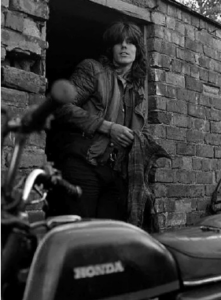
When the visa expired, he returned to the U.K. to complete his degree, and then came back to Canada, where he worked as a mechanic at Toronto’s T.O. Cycle. He met a local girl and they got married, both of them in their early 20s, and still he was ambitious for more. “While he was doing his motorcycle mechanicking,” says Courtney, “he found that wasn’t quite enough interesting stuff to do for him, and so he started writing about motorcycles.”
Rob later explained the 1994 creation of the Toronto Motorcycle Guide in an interview with the Toronto Star: It was “something that used my brain and my love of bikes, and to a certain amount the engineering degree – the trouble with engineering is you can’t make jokes.”
Rob’s smiling on the chair opposite now, and nodding. Those were exciting days in Toronto, printing a paperback-sized, 28-page edition every couple of months. Its first cover was photocopied on pink paper to make sure it stood out, and Rob also used the colour to get away from the traditional machismo of motorcycles. After a year, the scope of the magazine expanded to cover the province and it became Ontario Motorcycle Guide, with roughly 3,000 copies distributed for free at bike shops.
It was successful enough that Rob quit his mechanic’s job and took an income from the magazine’s advertising, though he still had to make ends meet by tending bar at the Shark City Athletic Club on Eglinton Avenue East. The pressures of work and never having enough money helped take a toll on his marriage – “we were far too young,” he said later – and they divorced after just a couple of years.
The magazine weathered through, however. Canadian Motorcycle Guide – or CMG – began as an accompanying web site in 1996 when an enthusiastic reader, Patrick Shelston, offered to set it up, just for the experience. And when an insurance broker agreed to mail OMG to his clients, circulation was bumped to 11,000 an issue. Advertising started to be more profitable. But then the brokerage was sold, and a replacement deal to distribute through the Motorcycle and Moped Industry Council was short-lived, and “basically, OMG finally ran out of steam,” said Rob in the Star interview. “We tried all avenues to keep the circulation up, but it couldn’t be done.”
The magazine folded at the end of 1998, and Rob took off for a couple of months to Australia to rethink his options. But the Web site lured him back and he took on another job to help pay the bills, teaching motorcycle mechanics in the evenings at Centennial College. There were more girlfriends and relationships, and always motorcyclists coming and going through his life.
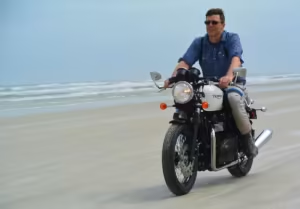
Rob introduced a number of contributors and many are still in the business; he gave a first break to Canadian writers like Costa Mouzouris and Steve Bond. At the turn of the millennium, one regular contributor was a young, professionally-ranked roadracer named Piero Zambotti, who left to become an associate editor at Cycle Canada magazine. In 2003, when Piero went off the road riding a Honda Gold Wing near Dorset, Ontario, and died in the ambulance from a ruptured artery in his chest after the stupid, senseless, unexplained crash, Rob was stunned.
***
Rob’s head is bowed now in the chair across the room, but let’s get this straight. People will say he was killed by motorcycles. They’ll say bikes are dangerous, and they’ll say he was selfish to risk his life with them. People who never knew him will shrug and say, well, what do you expect?
If Rob had been driving a car, he would not have died in the collision. The combined speed of the two vehicles was not much more than 50 km/h, and seat belts and air bags would have saved his life. But Rob would not have been driving on the road in a car, because he had no reason to do so. His motorcycle though – that was a reason to be there, and to live life to the fullest.
“I’ll admit I may have enjoyed this road at a rather quick rate of knots,” he wrote last year about the Black Donald Road, a paved road near Calabogie that’s not so far away, “but, like so many of the roads around here, it pulls you into a semi-hypnotic groove. Your mind releases its burden and automatically pulls all the mental levers into sync to guide you and machine effortlessly through the landscape.” That’s what he would enjoy the most on his motorcycle.
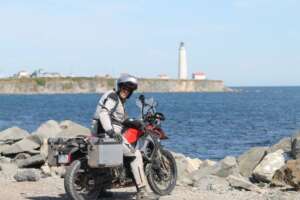
Rob was a skilled and careful rider. He never owned a car, though his name shared the registration for Courtney’s Kia. He was responsible on two wheels. He knew he had to be, because after all the work and all the struggles, he had a young family he loved even more than motorcycling. Like all of us who ride, he felt he could minimize the risks through caution and experience, and he did, down to almost no risk at all. This gave him far more personal fulfillment than he could hope to achieve without motorcycles, and he always treated the machines with respect.
“He was always aware. It was always in the back of his mind,” says his friend Costa Mouzouris, who was on that fatal ride with Piero. “It’s always there, always a concern, but you don’t think it will ever happen to you.”
***
Rob moved to Montreal soon after Piero’s death, partly to change up his life but also to make a fresh start away from a failed relationship in Toronto. Montreal was vibrant and he was close to his aunt; the fact he spoke no French whatsoever was never a concern.
Soon after his arrival, he turned up to register for a rally at St.-Saveur with his best friend, Jim Vernon, another transplanted Brit in Montreal who loved motorcycles, and the volunteer registration clerk was Courtney Hay. They began dating and then moved in together. Courtney’s government HR job helped pay the bills.
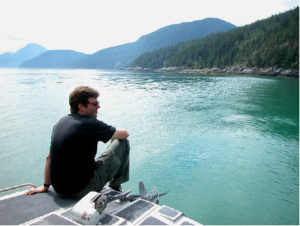
There was enough money to take a vacation and the two of them went to Mexico. It was there, on a beach, that Rob got down on one knee and proposed to Courtney. Actually, typical for Rob, his knee hurt so he had to get down on both knees and present Courtney with a ring he’d just bought from a hotel vendor with his last 50 bucks. Courtney said yes, but they never did set a date.
Their first daughter was born soon after, named Cate for the Cate Blanchett movie they watched while Courtney was in labour, two months early. When Courtney was pregnant the following year with their second child, they decided to move from Montreal to give their children a better life in a more affordable, family-friendly environment. Courtney’s father owned a holiday cottage on the beach near Bathurst, New Brunswick, and they started looking there for a place to call home.
“I knew I could transfer my job to Moncton, so we went looking for places in commutable distance and we found this lovely little town in Sackville,” remembers Courtney. “We stayed at the Marshlands Inn, where the Queen stayed, so we felt it was all good then, and everything just fell into place.” They bought a house on the edge of town and moved in during the summer of 2009, when Chloe was just five weeks old.
Courtney helped Rob with his CMG responsibilities. That included organizing the bi-annual running of the Mad Bastard Scooter Rally – an 800-kilometre roving rally that Rob founded in 2003 with three friends who rode around Lake Ontario on 50 cc scooters. Like most of Rob’s ventures, it grew in popularity because it was different from anything else on two wheels and it raised thousands of dollars for Kids’ Helpline, but it didn’t actually make much money for CMG.
It was not easy for either of them to juggle parenthood with work, and Courtney began to resent her bureaucratic job. The marriage was strained, but she admits it was Rob who fought hardest for what they had and who kept them together. It was Rob who told her to quit her cubicle job, and to join him at CMG. And Courtney looked at the clutter that was burying the efficiency of the business and took over its organization, selling its advertising and leaving Rob free to work at making the content the best it could be. Everything finally came together, and the last two years were perhaps the happiest of their lives.
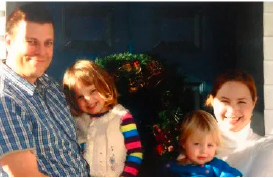
In 2014, Rob visited his family in the U.K. and asked his sister Sarah for their mother’s wedding ring. Sometime around Christmas that year, just after dinner, he asked the girls to call their mother into the dining room. Then he asked them to help him get back down onto two knees, and he presented the second ring to Courtney and asked her again to marry him. “I want you to know I’ve got your back,” he told her. “I know you’ve got mine and we’re in this together.” It was a renewed commitment for them both to each other and they were stronger for it. Courtney now wears both rings, but still, a date was never set. There were many other challenges to deal with first.
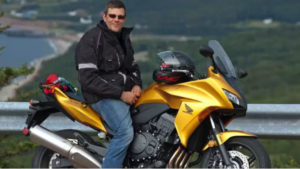
In New Brunswick, Rob had found a love for exploring the province’s back roads on dual-purpose motorcycles and recognized there was a viable business in promoting two-wheeled adventure tours of the area. The two of them created the Fundy Adventure Rally, and its inaugural 500-km ride in 2014 attracted 61 riders from Canada and the United States. Last year, there were 91 riders. The rally this coming September, with potential sponsorship from BMW and Honda, promised to continue the growth and the success.
Rob had big plans for CMG, now called Canada Moto Guide to satisfy both French and English readers: new contributors, a new focus, maybe even expansion into the U.S. Rob was spending more time on dual-purpose motorcycles and attended the launch of Honda’s Africa Twin this spring on Vancouver Island.
And then, last week, he flew to Montreal, met his friend Jim Vernon, and the two of them loaded Jim’s Honda CRF250 and a Husqvarna 701 test bike into Jim’s van. They drove to the Elmhurst Resort on Rice Lake, an hour north-east of Toronto, for a weekend of dirt-road rally riding.
***
“If I were in a sci-fi movie, my nemesis would be Dr. Sand, and his weapon would be grooves,” wrote Rob in his notebook that Friday, after trying out the Husqvarna at the resort. “If you look at the grooves of Dr. Sand, you are dead. You have to look ahead, apply a steady throttle, and trust that the 701 will steer through it….
“This is the Ganaraska Forest. A wonderland of trails to discover – wide, narrow, safe trails … but mostly sand. The 701 could do it, but I wouldn’t say it was its happy place.”
And then the next day, a damp Saturday morning, he wrote: “Weather!” He and Jim and another rider named Herb set off on an organized ride following a 300-kilometre loop north of the resort and tried to stay ahead of several dozen other riders on larger adventure bikes. When those riders stopped for gas, Rob scrawled more notes in his notebook – “Managed to keep ahead of the horde” and “Rallies are very weather dependent!” – and then he and Jim got a 10-minute head start and rode north up the Old Hastings Road.
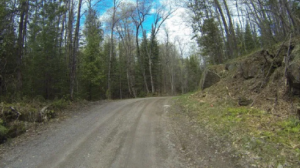
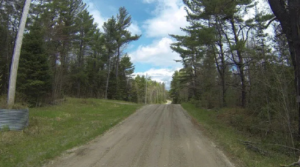
The Old Hastings Road was built in 1854 to try to settle the area between Hastings and Bancroft. It was intended for horses and sleighs, but the poor soil meant there was little settlement and little use for the road. As such, it was never improved but just left to connect a few houses and hunting cabins. It twists and winds and whoops and dips for about 50 kilometres, and it’s a wonderful, narrow, little-travelled dirt road, with occasional patches of sand.
Jim says the two of them were riding at probably 50 km/h, perhaps a little slower than they might have done because the road was slippery from the damp. Rob was in front – he wouldn’t let Jim ride ahead because he said Jim would probably crash, just as he’d done on a ride through Labrador several years earlier. About four kilometres south of Ormsby, population 20, the road drops deep into a hollow and then rises to a crest that turns gently to the right. On the north side of the crest, there’s at least 100 metres of road that’s also in a hollow, too deep for any vehicle on it to be clearly seen from the south. On the road in that hollow, four members of a local family were driving home from Bancroft after picking up their mother from her shift at the thrift shop. Rob crested the hill in the centre of the lane, confident he could see a clear road ahead, the two motorcyclists well into the rhythm of the ride, 15 minutes from lunch.
“I heard the crack of a motorcycle throttle, and then I heard a backfire,” recalls the owner of a hunting cabin just south of the hill. “Except it wasn’t a backfire. It was the sound of the gentleman’s helmet hitting the pickup truck.”
Rob saw the truck on the other side of the crest and would have had a split-second to react. He dropped the Husqvarna and it slid through the dirt to the left, while he slid straight ahead. The left side of his helmet hit the driver’s-side bumper of the blue Ford F-150. The truck had been driving slowly but the driver slammed on the brakes and was almost at a standstill for the collision. All the force of the impact was in Rob’s speed and it was a head-on crash. All the Kevlar, all the fiberglass and carbon composite, cannot protect the brain from such a collision. As well, the impact broke Rob’s ribs, which in turn ruptured his heart and the arteries in his chest.
“He would have been unconscious in a heartbeat, literally,” reported the coroner. “Just a moment to know that something was happening, and then he was gone. Such a rupture stops all blood pressure instantly and the brain immediately shuts down. He would have been dead just a few moments later.
“This really was a flukey kind of thing. One missed gear change and he wouldn’t have been there. He’d have been a fraction of a second back on the road and would have seen the truck in enough time. But he wasn’t. He was in the worst possible place.”
Police and paramedics were there within 10 minutes, and the pickup truck driver worked CPR on Rob until they came, but there was nothing to be done. Courtney, at home in New Brunswick, was told of Rob’s death by police officers who came to the house. Her mother was visiting in his absence, there to help with Chloe’s seventh birthday the previous day. The two of them flew the next day with Cate and Chloe to Toronto. Courtney drove out to Kingston with her brother and father to formally identify Rob’s body at the hospital. It was barely 30 hours since the collision, and he was still dressed in his riding suit. There was a cut on his lower lip, but otherwise he looked peaceful.
“You know that little smirk he had?” she says. “That downward turn of the ends of his mouth, while smiling at the same time? He had that when I saw him. He looked beautiful.”
***
Rob’s been listening to his story in the chair, staring at the floor for the last little while, but now he’s looking up and his eyes are quizzical. He wants to know about the letters. It’s okay. Courtney has the letters. Rob softens and nods and smirks that little smile. There’s a letter for each of their daughters, typed out by him before he went away on a motorcycle trip in 2011.
“My dearest Cate” and “My dearest Chloe”, they begin. “I am so sorry that you are reading this now. It means that something has happened and that I shall not be seeing you again.”
He tells of his hope that Courtney is with them, and his faith that she’ll provide for them. He tells of how he grew up without his mother and how he regrets that they will have the same hole in their lives. But then, as Rob would always have it, he shifts and looks toward the future.
“Don’t be sad for too long, and don’t let any sadness get too deep into your soul,” he tells his daughters. “The world is a wondrous place and life a precious if somewhat fragile experience. It should be lived to the full and without fear.
“So, be strong. Live life to the fullest. Respect your fellow human being. Treat your friends well. Love and honour your family and live life as the main performance, not a rehearsal.
“I love you both and I want to thank you for being in my life. I didn’t think that I would experience life with children but then I hadn’t met your mother. It’s perhaps the most important and fulfilling thing I ever did and please know that I died a complete and happy man for having you both in my life.
“Much love and adoration forever. Be strong. Dad.”
And Rob’s gone.