

Today is the 46th anniversary of the tragic highway crash in Saskatchewan that killed 22 members of CPR’s steel gang. I wrote about the crash in The Drive Across Canada, and the relevant passages, from the chapters in Saskatchewan and Alberta, are excerpted here.
The bus crash near here in 1980 that killed 22 men and left only eight survivors is still by far the greatest loss of life for any collision on the Trans-Canada Highway. There’s a memorial beside the road, half an hour on from Swift Current, and Peter and I paused there to take it in.
It’s a lonely place. Some trees on the south horizon suggest there might be farm buildings over that way, but everything else is grassland. The memorial itself is in the crook of a gravel road at the point where it turns to meet the Trans-Canada, and there was a plume of dust from a truck far down that road to the south. And then there was the main highway itself, with widely spaced cars and trucks droning past, not stopping here as they drove west or east. Maybe noticing the maple leaf flag flying from the monument site. Maybe not.
The memorial remembers the wet afternoon on May 28, 1980, when a CPR steel crew that was fixing tracks left work early to return to Gull Lake, riding in a pair of yellow school buses. The Trans-Canada was just two lanes then, and somewhere near the town of Webb, an oncoming black Chrysler strayed over the centre lane and sideswiped the second of the crew’s buses. The car was driven by two men who had been drinking at the Swift Current Legion. The bus was knocked sideways and skidded over the centre line, directly into the path of a tanker truck loaded with more than 34,000 litres of asphalt oil, heated to 65 degrees Celsius. The tanker exploded with the impact. “It was just a massive horrible, horrible sight,” said an eyewitness. “There was a mass of flame and there were bodies all over lying around. Oil was burning and splashing all over. They got their share of it, too, some of the people who were trying to save the others. The whole thing was absolute chaos.”
Most of the crew were young men from Manitoba or Newfoundland, living on a train parked at Gull Lake and moving around to wherever the work was needed. At a memorial service two days after the crash, when 500 people filled the First United Church in Swift Current, somebody suggested a collection should raise money for the victims’ families. Donation boxes at local churches and banks raised $3,000 that was distributed to the families, about $136 for each person who died. Canadian Pacific Railway returned the bodies to their homes and paid for the funerals, and then a few months after the crash, a bronze plaque was unveiled at the rail tracks in Swift Current that carried the names of the 22 victims. An engineer had started a collection and raised $1,627 from his fellow workers to pay for the plaque, which left $2 to spare. The truck driver survived and the two men in the car were uninjured. They weren’t breathalysed for alcohol at the chaos of the scene. An inquest the following year recommended twinning the Trans-Canada Highway and installing seat belts in buses, and the provincial attorney general said no criminal charges would be laid against the driver of the car. And that was that.
The Trans-Canada was twinned at the site in 1983, though it took until 2008 to twin the entire highway across the province. It also took until 2007 for the memorial we visited to be built near the site of the crash, with help from the local Teamsters. It’s a tall cross made from railway track, mounted on a couple of metres of laid track, with a brass plaque remembering the victims. When we were there, some plastic flowers were tied to the cross with string and a small Newfoundland flag. It was sad and sombre, and I wouldn’t have noticed it if it wasn’t for the maple leaf flag flapping behind in the wind, a flash of red and white against the blue sky.
The township administrator told me the flag was purchased privately by a woman in Medicine Hat, just across the line in Alberta. So Peter and I continued west, out on the wide and smooth Trans-Canada Highway across the lonely prairie, to find her and ask the question: “Why?”
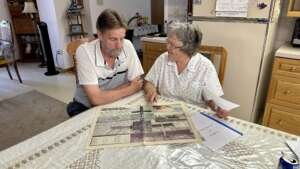
Peter and I wanted to visit Marina Gilchrist, who is the cousin of Michael Beach, driver of the school bus in Saskatchewan in which 22 people died in 1980. It was a summer job for Michael, who was 24 years old and studying social work in Winnipeg. His dad was a CPR engineer and helped get him the work. By coincidence, Marina is also the cousin of Warren Beach in Ernfold, and she visited the village just a couple of weeks earlier with her husband, Mike, to attend its Cemetery Day. That’s when relatives gather from around the country to remember the people buried in the cemetery there.
“We didn’t stop at the memorial this time, but we knew it was coming up, and we saw the flag there,” said Mike, sitting beside Marina at their kitchen table as we chatted. “We see it every time we go by, and we always acknowledge it. It helps us remember what happened.”
The flagpole is relatively recent, and Marina said she paid for it when it was clear the monument committee and the local township wouldn’t. It cost just over $500, and since then, her two cousins who were sisters of Michael Beach picked up the expense. “When the flag wasn’t there, nobody noticed [the memorial],” she said. “Nobody stopped. I don’t think they knew what it was. I wanted people to acknowledge what happened there and remember the people who were killed. For me, it means something. It’s a personal thing.”
“In our opinion,” added Mike, “we thought they were forgotten too fast.”
Forgotten by Canada, perhaps, but not by their families far away. “I think about it all the time,” Yvonne Edwards told me when I phoned her later. Her older, only brother was Richard “Tommy” Slaney, who was killed that day, age 25. “I think about everything he’s missed out on. He loved kids and stuff, but he never met any of his nieces or nephews. His motto was ‘live fast, die young, be a good-looking corpse.’ He loved the rock and roll.”
Tommy had started out as a surveyor with the Alcan mine in St. Lawrence on Newfoundland’s Burin Peninsula. When the mine closed, he went out west with his friends to work on the tracks for CP Rail until he could find another surveying job. It was the luck of the draw that he was riding in the bus that was struck. His family at home in St. Lawrence saw the news of the fiery crash on television that night; it was the first they knew of it, and no names of victims were released, but one of the images at the scene showed a workman’s hard hat laying on the scorched ground. It was light blue from the Alcan mine. Distinctive. “Mam said, ‘That’s Tommy’s hat,’” remembered Yvonne. “Dad said, ‘Don’t be foolish, there’s thousands of those hats around,’ but the next morning, of course, when the RCMP showed up, we knew.”
It took three weeks to identify Tommy’s body — he was originally misidentified as one of the two Seward brothers, both killed and badly burned, and he was buried by mistake at the Sewards’ church in Hodge’s Cove three hours away. When the mistake was discovered, his body was exhumed and brought to the church in St. Lawrence, but Yvonne says that, aside from some CPR lawyers who had her parents sign forms to not hold the company liable for Tommy’s death, nobody ever spoke to her mother, Theresa, about the tragedy. Not for 30 years. Not until one of the survivors, Gerald Synard, helped arrange a local memorial identical to the Saskatchewan one from three years earlier. It’s at the Christ the King Catholic churchyard at nearby Rushoon, a town of a couple of hundred people an hour away on the same Burin Peninsula. Eight young men from Rushoon were on the bus — four died and four survived.
“Nobody likes to talk about it,” said Yvonne, “but for my mother — she’s 92 now — that was the first time, at that memorial service in Rushoon in 2010, that anybody involved with it spoke to her about it. She was really happy for that. Counselling was unheard of back then. It’s just the way it was. In Newfoundland, all your families are very close-knit and it’s your family and your friends that gathers around you. But nobody ever spoke of it.”
Angus Moores doesn’t believe that’s such a bad thing. He was on the bus that afternoon, and he remembers everything right up to the impact. After lunch, “the rain basically washed the clothes off everyone’s backs, it rained that hard,” he told me later, speaking on the phone from his home at Rushoon. “Everyone just wanted to get on the bus and have a nice warm-up and have a smoke, and maybe a lot of the guys were already sleeping, because everyone was probably soaking wet.” Angus wasn’t sleeping, though. “I saw the car coming, yes. I saw the truck. I braced myself around the seat in front of me until the impact happened. I basically waited for the accident to happen. I stayed with the accident until the crash, and then I guess I was knocked out. The hospital had everything set up on the lawn, and I do remember lying on the grass, but I had no idea at the time, with the shock, if I was in an accident or not. I saw all the doctors and nurses there, but I had no idea where I was to.”
He had a ruptured spleen and spent a month in intensive care before returning to Newfoundland. He didn’t work for a year. “I do not think about it every day,” he said. “I am always reminded of it, and yes, it’s there, but I never — you’ve just got to try to not let it bother you. I didn’t refuse to think about it, but it’s just that I told myself, I got to live with this, right? I don’t know why I got saved, nobody can answer that, but I did survive and then I told myself, well, I can’t let this bother me as such. I’ve got to move on and I’ve got to make the best of it.”
Gerald Synard, who pressed for the two memorials to be created, found it more challenging to move on. He died recently from cancer, but he told a reporter at a later memorial service that “there’s a lot of survivor’s guilt,” that only builds each year as the May 28 anniversary grows nearer: “You get pretty on edge. There’s all kinds of emotions that start to take over.” Another survivor from Rushoon, Mike Lake, told another journalist in 2010 that “even the sight of a school bus gives me the shivers.”
When Angus Moores resumed work, he left Newfoundland and went back to CP Rail where he found a job administering the work crews in western Canada. It became a 32-year career, based in Vancouver. He was the person responsible for booking hotels, chasing the crews around British Columbia, Alberta, and Saskatchewan, getting the garbage removed, whatever was needed, that sort of thing. He passed through Webb many times. “Of course, the accident was always on your mind, naturally,” he said. “I knew I would be reminded, especially when I first went back and the crews still had the bus. The crews were still being transported by the school buses, right? So my first time on the bus, there was, yes, you know, of course, my mind was different when I stepped on the bus the first time. In 1980, we were just kids. We left Newfoundland, we went to the mainland, and got this great job with CP Rail, and they paid us good money, and hey, we were the happiest kids on the block. It was just a summer job. I lost all my friends, all my buddies. We were like one big family because we worked together so closely.”
Angus told me he wouldn’t be at the memorial service on the next May 28. “I have to drive past the church every time I pass up the street, and I’m reminded every time that the memorial is there. I know it’s there. I stopped going for no particular reason. I had the opening, and I did not want to go year after year and attend the memorial. I haven’t gone in a few years. I don’t want to be at the centre of ‘I survived.’”
But for everyone else, why did it take so long to memorialize the dead? “We were all isolated in different communities and nobody got together,” said Yvonne. “They were just too traumatized to talk about it. Especially Gerald. You could see the pain in that man’s face. Anytime you spoke to him, you know, it was just something that never, ever, left him. He told me, he woke up and he was in the wheel well of the bus — that’s what saved him. A lot of it was survivor’s guilt.”
She told me her mother will always stop now at the Rushoon memorial when she travels past on her way home to St. Lawrence. Theresa can sit there for hours, and for the other relatives involved in the crash, it gives them some peace. It helps them to share the burden of grief.
And the Saskatchewan memorial? What good does it do there so far from the homes of the victims? Has Yvonne ever been there?
“No, but it’s on my bucket list,” she said. “I just want to look around at where he spent his last moments. Whenever any of my friends go to the site, I’ll give them little mementoes, a little Newfoundland flag, or a beach rock or something from home, just to lay, you know? I think it’s important for the people who live there, who helped rescue the survivors, to be able to remember what happened, so they can talk about it too, but once all the people impacted by it are gone, then that will be enough. I don’t think future generations are going to remember them like we do. But for now, we need to remember them.”